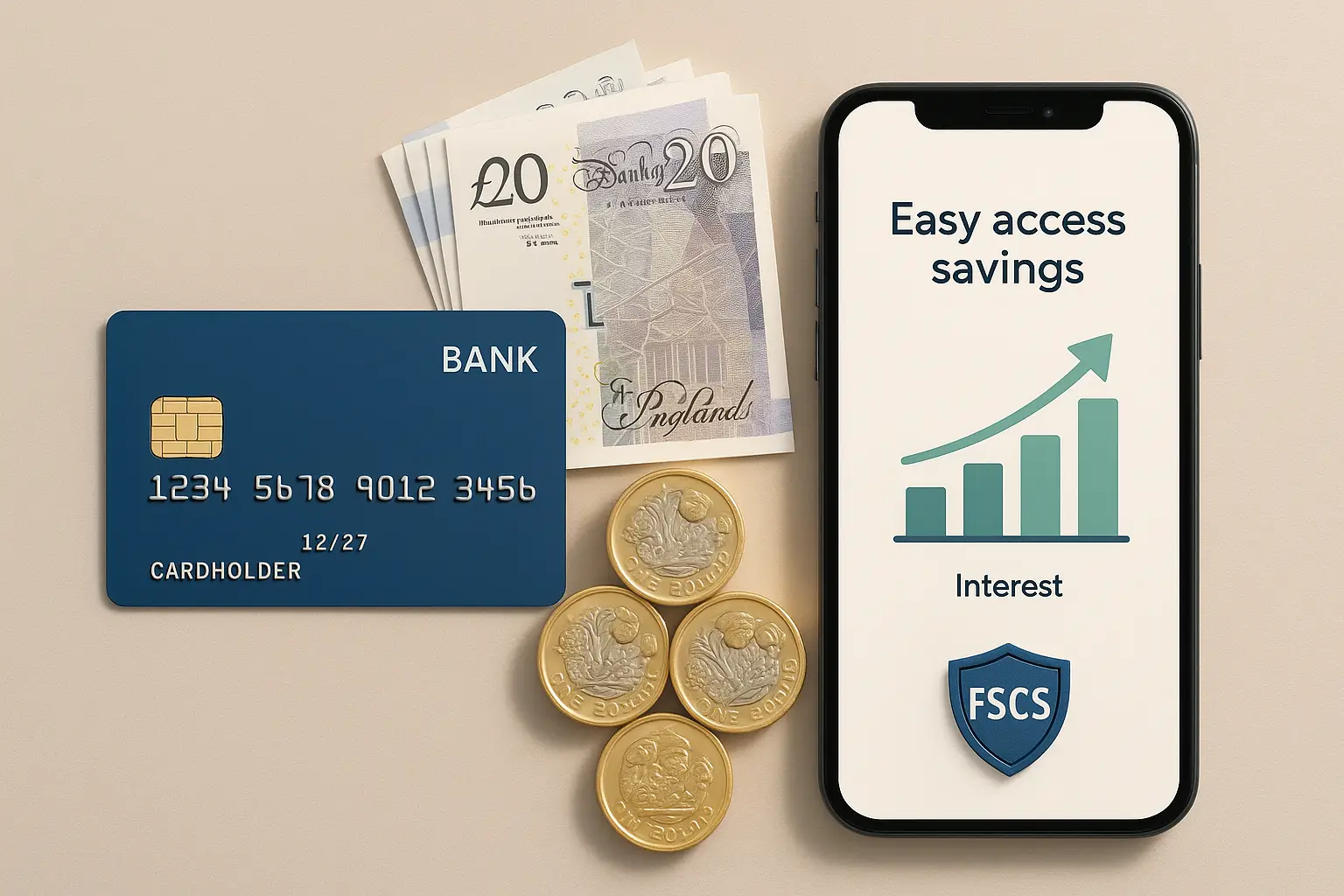

What is an easy access savings account?
Easy access savings accounts explained start with understanding their core appeal: flexibility without penalties. These accounts let you deposit and withdraw money anytime, ideal for UK savers needing quick access to funds. Unlike rigid options, they offer variable interest rates that can change, often linked to the Bank of England base rate of 5% as of late 2025.
Definition and key features
An easy access savings account is a type of savings product from UK banks or building societies where you can add or remove money freely. Key features include no notice period for withdrawals, daily or monthly interest compounding, and protection under the Financial Services Compensation Scheme (FSCS) up to £85,000 per person per institution, as outlined by Moneyfactscompare in 2025. Minimum deposits are often just £1, making them accessible for beginners.
Differences from other savings types
Easy access savings accounts uk differ from fixed-rate bonds, which lock your money for a set period at a guaranteed rate, or cash ISAs, which offer tax-free interest but may have access limits. While fixed-rate savings provide stability, easy access prioritises liquidity, suiting emergency funds over long-term growth. For a deeper look at best easy access savings, explore comparisons elsewhere.
Eligibility and who it’s for
Most UK residents aged 18+ qualify, with some accounts open to younger savers or joint holders. They’re perfect for those building an emergency pot or parking cash short-term, with over 12 million UK adults using them and average balances around £5,000, per the FCA’s 2024 Savings Market Report.
How do easy access savings accounts work?
Interest on easy access savings accounts is calculated daily and paid monthly or annually, using AER (Annual Equivalent Rate) to show true returns. Withdrawals are unlimited without notice, but rates can drop if the base rate falls.
Interest earning process
Money earns variable interest that tracks market changes, like the 5% Bank of England base rate in 2025, according to OakNorth Bank. For example, on a £1,000 balance at 4% AER, you’d earn about £40 yearly, compounded to maximise growth. Rates are quoted as AER to compare fairly across providers.
Withdrawals and access rules
Access your funds instantly via online banking or app, with no penalties—hence “easy access savings accounts explained” as flexible tools. Some limit free withdrawals to a few per year, so check terms to avoid fees.
Tax considerations in the UK
Non-ISA easy access accounts count towards your Personal Savings Allowance (£1,000 tax-free for basic-rate taxpayers). Interest over this is taxed at your income rate; consider a cash ISA for tax-free saving up to £20,000 annually.
| Feature | Description | Example |
|---|---|---|
| Minimum deposit | Often low to encourage starting small | £1 with many providers |
| AER calculation | Annual rate including compounding | Up to 4.75% as of October 2025 |
| Withdrawal limits | Typically unlimited without notice | Instant via app or transfer |
| FSCS protection | Covers up to £85,000 per institution | Applies to authorised UK banks |
Pros and cons of easy access savings accounts
The main benefit is flexibility, letting you respond to life changes without losing interest, though variable rates pose risks if they fall.
Advantages for flexible saving
Benefits of easy access savings include immediate access for emergencies and easy top-ups, outperforming current accounts’ near-zero rates. They’re great for short-term goals, with top rates reaching 4.75% AER in 2025, per MoneySavingExpert.
Potential drawbacks
Rates can drop suddenly, and while accessible, temptation to spend may erode savings. Compared to fixed-rate options, returns might lag in stable economies.
Risks and protections
Risks of easy access savings accounts include inflation outpacing rates, but FSCS safeguards your money if the provider fails. Spread deposits across institutions for full coverage, as detailed on the FSCS website.
How to choose and open an easy access savings account
Prioritise AER, provider reliability, and access ease; current easy access interest rates hover around 4-4.75% in 2025. Shop via comparison sites without committing to one.
Factors to consider
Look at variable rates tied to the base rate, minimum deposits (£1 typical), and online vs branch access. Avoid low-rate high-street banks paying below average, as noted by Moneyfactscompare.
Step-by-step opening guide
1. Research providers and rates online.
2. Check eligibility (ID, address proof).
3. Apply via website or app (10-15 minutes).
4. Verify identity electronically.
5. Deposit funds via transfer.
6. Monitor via app for interest and access.
This process is straightforward for most, per money.co.uk in 2025.
Current rate overview
As of October 2025, leading easy access rates offer up to 4.75% AER, influenced by the 5% base rate. Rates fluctuate, so verify latest figures.
Frequently asked questions
What is an easy access savings account?
An easy access savings account allows penalty-free withdrawals and deposits, with variable interest paid on balances. In the UK, they’re popular for flexibility, protected by FSCS up to £85,000. Ideal for beginners, they differ from locked accounts by prioritising access over higher fixed yields.
How do easy access savings accounts work?
They work by earning daily interest on your balance, credited monthly or annually at a variable AER. You can withdraw anytime without notice, but rates may change with economic shifts like base rate adjustments. For instance, at 4% AER on £5,000, you’d gain around £200 yearly, compounded for better returns.
What is the best easy access savings account?
The best depends on your needs, but top UK options in 2025 offer 4.5-4.75% AER with easy online access. Factors like provider stability and no fees matter; compare via trusted sites for current deals without overcommitting. Always check for FSCS coverage to ensure safety.
Are easy access savings accounts safe?
Yes, in the UK, they’re safe if from FSCS-authorised providers, covering up to £85,000 per institution. Variable rates carry interest risk, but your capital is secure barring bank failure. Diversify across banks to maximise protection, avoiding over £85,000 in one place.
Can I have more than one easy access savings account?
Absolutely, holding multiple enhances flexibility and spreads FSCS protection across institutions. For example, use one for emergencies and another for goals; this strategy mitigates risks from rate changes. Track balances to stay within allowances and tax thresholds.
What is AER in savings accounts?
AER (Annual Equivalent Rate) shows the true yearly return, accounting for compounding—e.g., 4% AER means £4 on £100 after a year if interest reinvests. It’s standard for comparing easy access savings accounts uk, as it reveals effective earnings beyond headline rates. Use it to evaluate value, especially with variable adjustments.